

SOI SILOM 19, BANG RAK — It was 4 p.m. on a Saturday inside Breakfast Story Si Lom. An English roundtable was just getting underway, picking up where a two-hour Thai discussion had left off.
Around 10 people, hailing from Bangkok, Pathum Thani, Nonthaburi, Israel, China, France and the U.S., gathered in the cafe.
“We can talk about things that you want to talk about,” Pimchanok Chuaylua told the group’s host for the hour, Byron Levy, a frequent attendee. He then selected a prompt for the table: “How do you use AI in everyday life?”
Across the room, a smaller trio traded basic morning greetings, practicing how to say “it’s four o’clock” and “what did you eat this morning” in Thai and Chinese.
For Levy, an American from Lak Si, the gatherings offer something traditional language schools don’t. While conventional classes focus heavily on reading and writing, he said he was looking for a place to actually speak.
“Speaking Thai with people, especially speaking about topics that I’m not used to speaking about, gives me the chance to struggle, say the wrong thing and learn from it in a friendly atmosphere that doesn’t pressure you,” he said.
Because it’s a language exchange, he also gets the opportunity to help others with his native English.
That was a scene from a recent weekend meetup Lingping Club hosted.
Pimchanok, the club’s founder, envisions it as an intimate space where people can share and learn about new cultures through storytelling. Language, however, is just a part of it.
In Thailand, where 83% of people report feeling lonely, Pimchanok said even though they can now learn languages with AI, human connections are what keep people coming back.
“I feel like the need will be stronger in the future as AI grows,” she said.

Pimchanok Chuaylua, right, and two Lingping Club participants exchange Thai and Chinese vocabularies at Breakfast Story Si Lom in Bang Rak on Saturday, March 21, 2026. (Photo by: Chatwan Mongkol/Soiciety)
The accidental community
Today, Lingping Club hosts member-led language discussions across the city, capping each group at six people to maintain an intimate focus. Its activities include book clubs, city walks, roundtable discussions and online language classes.
But the community began entirely by accident.
Two years ago, Pimchanok was looking for a space to practice Chinese. She found most Bangkok language meetups were either too large or centered around drinking and smoking.
“I wanted to build something for myself, like a daytime, a group of six people discussing something over coffee,” she said.
At the same time, she was seeking a break from Bangkok’s professional expectations. She quit her tech job with a simple goal: to find something that made her happy.
She packed her gym clothes for what was supposed to be a weekend getaway to Chiang Mai. Hoping to practice her language, she posted on Facebook looking for people to chat with over coffee.
Three people showed up.
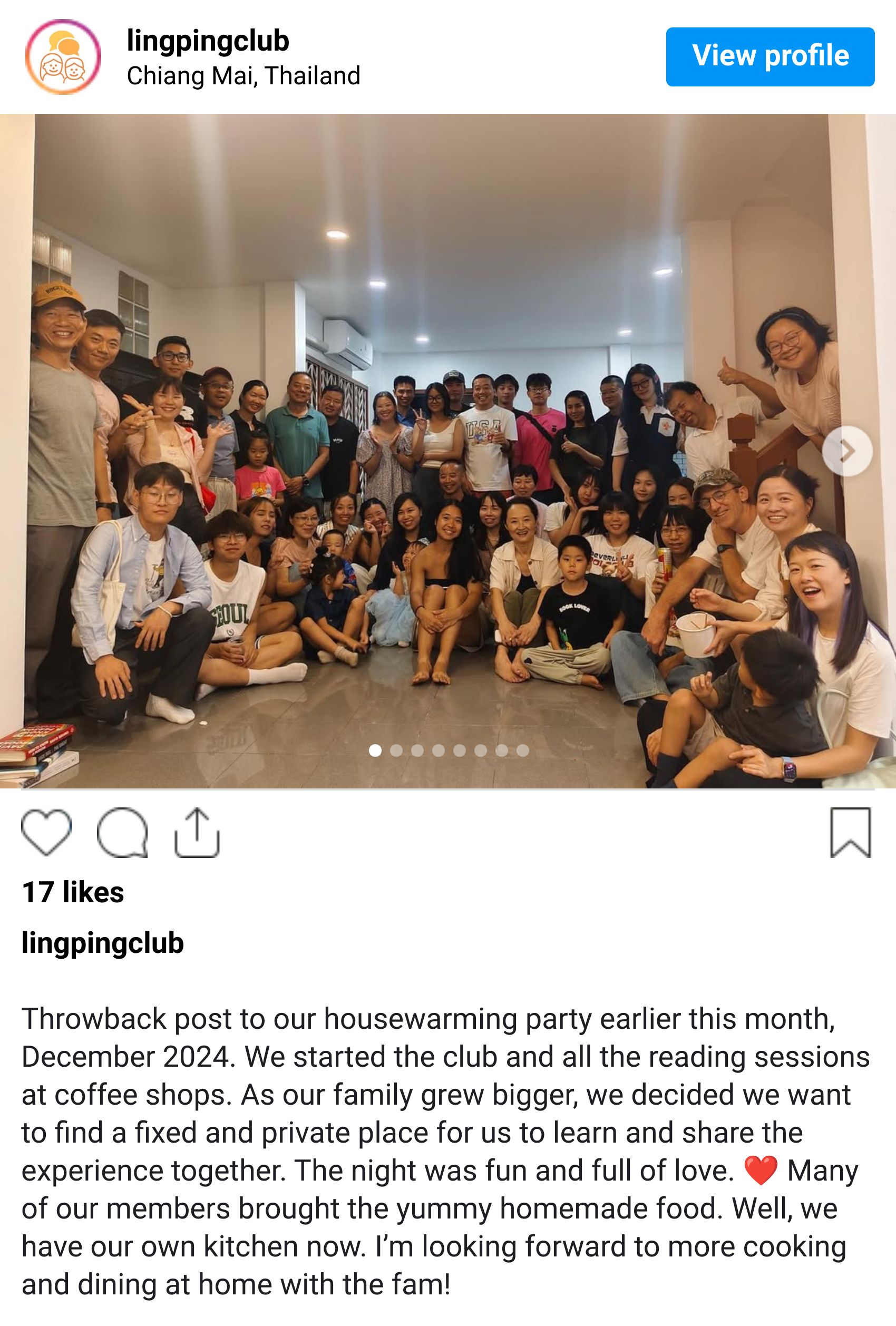
They kept meeting every day and posted pictures on Facebook. Soon, the small coffee chats ballooned into a community of over 50 people.
Realizing she didn’t need to return to Bangkok right away, she turned that weekend trip into a year-and-a-half stay, building her idea into a business.
Taking it to the streets
After the Chiang Mai success, she brought the Lingping model back to Bangkok. Because the city is denser and more diverse, she knew the iteration couldn’t just be confined to coffee shops. City walk was added.
“Simply put, it's just fun to explore the city with people,” Pimchanok said. “Coming back to Bangkok this time is new and interesting for me, and I feel like most expats feel the same way.”
Shortly after 5 p.m., the Si Lom group left the cafe and began to wander through the Bang Rak area. Leading the pack was Thamma Tharasombat, a 25-year-old from Nonthaburi.
A self-described “temple nerd” who speaks six languages, Thamma stepped into the role of an impromptu tour guide.
He told stories as the group walked past the Sri Maha Mariamman Temple, the Masjid Mirasuddeen and down a narrow soi off Surawong Road to a Hare Krishna temple, as that week’s weekly theme was religion.
Like the community itself, Thamma’s involvement was accidental. Back in February, he was walking past an art gallery in Si Lom when he crossed paths with another Lingping city walk.
Pimchanok stopped him and asked if he spoke Chinese.
“I said yes, and she asked me if I wanted to join the club,” Thamma recalled. “I had never known these guys before, not on social media or anywhere.”
He now attends at least once every weekend.
Even though he works at an international company, he said he rarely gets the chance to speak English outside of presentations, making the club an outlet to practice.

Thamma Tharasombat, right, shows Byron Levy Sri Maha Mariamman Temple in Bang Rak on Saturday, March 21, 2026. (Photo by: Chatwan Mongkol/Soiciety)
An antidote to screens
While language exchange is the main draw, Pimchanok quickly realized the club was fulfilling a much deeper need. In Bangkok, where expats and locals alike can feel isolated, she observed a growing craving for genuine human interaction.
Indeed, nearly 41% of Thai urban residents feel lonely, with office workers facing the most intense feelings, according to a 2025 survey by the Thai Health Promotion Foundation. One in five Thais also relies on AI for counseling.
“We have screens, phones and probably five devices at home,” she said. “But as a human, you need connections, so I feel like more people will need this.”
Large networking events often fail to bridge that gap, she noted, leaving attendees stuck in repetitive small talk. Lingping, she explained, provides an intimate space for people to go deeper on a topic. The club rotates themes and locations every week.
“That wasn’t my original goal,” Pimchanok said. “It’s a byproduct that I’ve observed, and I think that’s a plus and I’m glad it happened.”

Lingping Club event attendees talk after an English roundtable wraps up at Breakfast Story Si Lom in Bang Rak on Saturday, March 21, 2026. (Photo by: Chatwan Mongkol/Soiciety)
The business of community
Fostering those connections across a sprawling capital requires logistical lifting. Pimchanok lives in Lam Luk Ka, meaning every in-person event in central Bangkok comes with a commute of more than an hour from Khu Kot Station.
When she hosts back-to-back weekend events, she sometimes stays at a hotel in the city to manage her schedule.
“I feel like it’s working, but I’m having fun working,” she said. “I’m having fun, but after having fun, I feel tired.”
To sustain this effort without taking on a full-time job, the community runs on a paid model.
Lingping currently has about 100 paying members, with a monthly membership costing 1,000 baht and single drop-in events priced at 300 baht. The club also offers various packages for its online language classes.

Lingping Club members make a stop at the General Post Office in Bang Rak during their walk on Saturday, March 21, 2026. (Photo by: Chatwan Mongkol/Soiciety)
For Pimchanok, profit isn’t a contradiction to her community-building values — it’s the thing that enables the club to exist.
“Money and business are just something important, just like blood in your body,” she said. “If people enjoy us and they want to keep learning and want it to exist, they have to support the operations.”
Her ultimate Bangkok goal: Host Lingping small groups at different spots in the city simultaneously. She’s already experimenting with hosting in Lam Luk Ka, Rangsit, Chaeng Wattana and Ramintra.
Success metric
As the sun began to set, the Si Lom city walk came to an end at River City Bangkok.
Gathering the group together, Pimchanok turned her attention to the next weekend. Walkers began pitching their next destinations: Sampheng, Chinatown or Wutthakat.
“Where should we go next week?” Pimchanok asked the group.
But regardless of the neighborhood they chose or the vocabulary they managed to memorize, Pimchanok said she measures the club’s impact by a different standard: whether attendees leave feeling more curious than when they arrived.
At the end of every event, she makes a point of asking participants what new things they learned and what they are now more curious about.
“I want to see the sparks in that person’s eyes,” she said.
📍 Editor’s note: This story is the first in the new “From the Sois” section — originally reported features that will be published twice a month. To make more of this on-the-ground reporting possible, Society is moving toward a recurring support model. If you want to see more neighborhood-level journalism like this, read our mission and join the Soi Resident program to keep Soiciety independent and free for everyone.