

SOI PRACHARAT SAI 1 25, BANG SUE — For more than 50 years, a family compound tucked inside a soi off Bangkok’s historic wood-trading street operated as a sawmill.
It closed more than a decade ago. The buildings sat empty, the wood inside slowly rotting.
Lisa Sripatanasakul had a different use in mind. A pantomime performer for nearly two decades, she has turned the old sawmill into a black box theater called T. Namcharoen Playhouse.
The theater soft-opened in May with five performances so far and will fully open later this year. The campus includes 70- and 200-seat theaters, an artist residence, multipurpose spaces and a coffee shop.
The team envisions the theater as a low-barrier gathering place for the neighborhood while remaining affordable for independent artists.
“I want to make art a normal thing for people,” said Lisa, the founder of the theater and House of Mask and Mime. “Like going to the mall, there’s no need for much preparation or complicated decisions. I want it to become easy for ordinary people just to come and see a play.”
That goal reflects a broader shift in Bang Pho, where local businesses have promoted their woodworking heritage through the creative economy — an effort that earned them the 2023 Creative City Branding Award.
T. Namcharoen Playhouse is one part of that transformation. But Lisa almost abandoned the idea because Bang Pho isn’t known for theater.
She spent two years reconsidering the location before moving ahead for a practical reason: her family already owned the land.
“I thought this wasn’t going to work. Nobody’s going to come,” Lisa said. “It felt like it was not it. If we were in Ari, or somewhere like that, at least it’s close.”

The construction of a 200-seat “Quite Big” room and a coffee shop is underway at T. Namcharoen Playhouse in Bang Sue, Bangkok, Wednesday, July 29, 2026. Part of the theater is built from timber salvaged from a warehouse on the property that had deteriorated beyond repair. (Photo by: Chatwan Mongkol/Soiciety)

Construction workers work at T. Namcharoen Playhouse in Bang Sue, Bangkok, Wednesday, July 29, 2026. (Photo by: Chatwan Mongkol/Soiciety)
Instead, the response since the soft opening has surprised her. Lisa said people have been messaging the theater’s social media accounts asking what’s on.
“That has never happened with the kind of shows we used to do,” she said. “Normally, audiences follow artists. But here, a lot of people are messaging to ask what’s showing. That means they want to come here without even knowing what it is or who’s starring.”
Lisa called T. Namcharoen Playhouse “already a hit.”
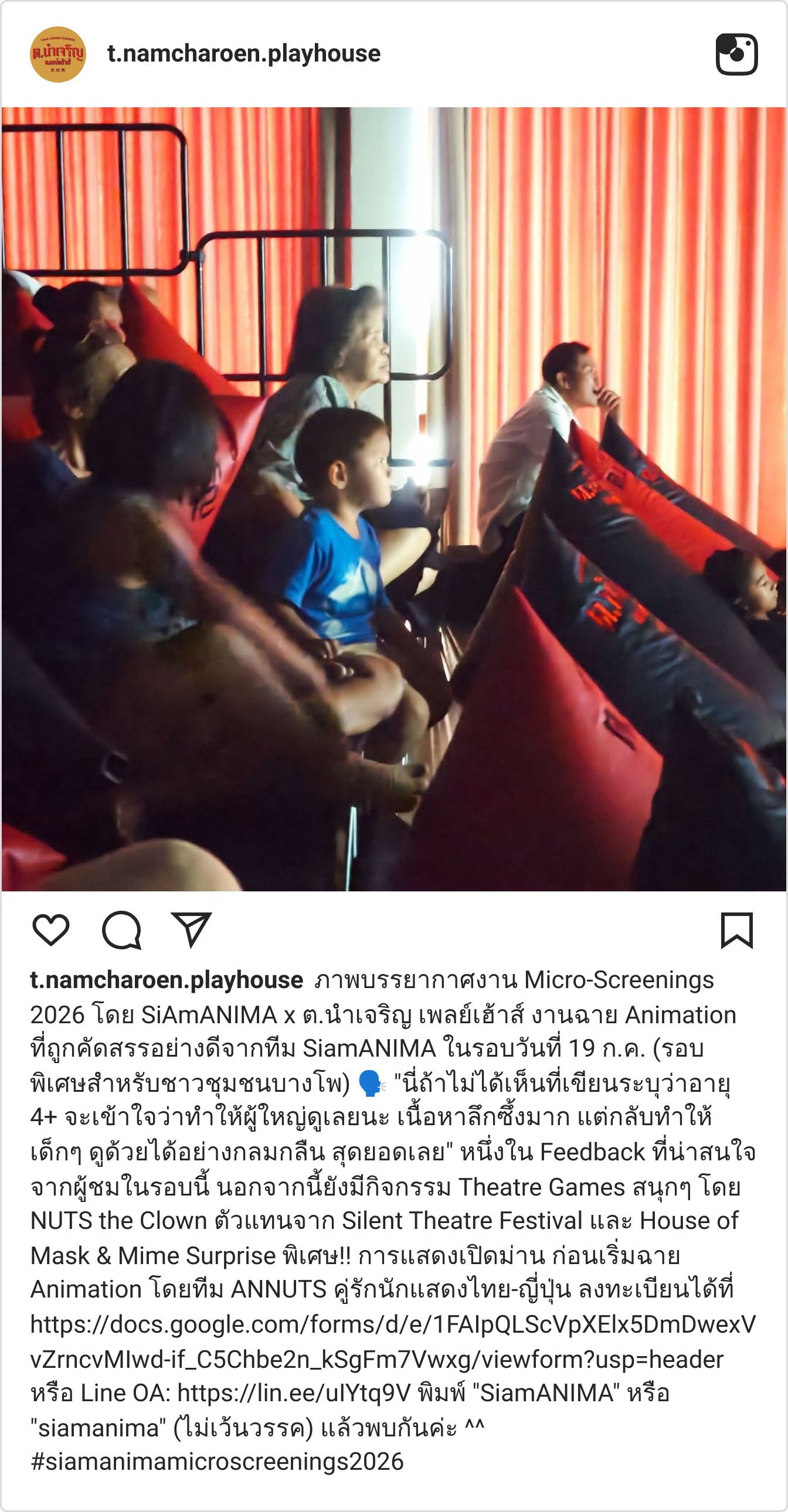
Annop Kitkason, the theater’s manager and director of Shangmime Project, said several productions have included free performances for neighbors, introducing some residents to pantomime for the first time.
“We see kids running around here now,” Lisa said. “They’re going to grow up with these new environments and new knowledge. I want to promote this and make it a standard here.”
Chama Panyanaramitdee, the theater’s curator and manager, said many audience members were surprised to discover a growing creative scene among Bang Pho’s traditional timber shops.
“They’ve heard about the good food, and they’ve heard about the wood being sold here,” she said. “But they are just realizing how much this new generation is creating.”
Even so, Chama said the area still isn’t lively enough to justify a full-day visit, the way Lisa’s mall comparison imagines. The streets around the playhouse remain lined with timber shops, vehicle hardware suppliers and furniture stores.
“There’s a nudge we can plant,” Chama said. “We’re trying to keep a full slate of programming, so this becomes one of the things people expect each month.”
A space built for those who can’t afford one
While the space aims to be a hangout for audiences — with tickets starting at 350 baht — it was also built to address a problem Lisa encountered as a performer.
After 17 years of performing at street festivals in Thailand and abroad, she began staging ticketed productions about five years ago. Finding affordable rehearsal and performance space, she said, was often the biggest challenge.

“Ar Par Tour” takes place at T. Namcharoen Playhouse between May 14-24, 2026. (Photo from T. Namcharoen Playhouse)
Her experience reflects a broader issue.
A 2025 mapping of Bangkok’s non-mainstream theater scene described the sector as “fragmented and fragile,” citing funding shortages and a lack of permanent homes for experimental artists. These problems have worsened since the COVID-19 pandemic.
“It’s hard to say this isn’t a business, because in the end, it still is one,” Lisa said. “But the productions that use a space like this usually don’t have much money.”
Rather than setting fixed rental rates, the playhouse negotiates arrangements on a case-by-case basis. The team didn’t provide a specific figure.
“There are a lot of options for how we can work with an artist,” she said. “It’s not just space for rent. It’s flexible.”
No fixed plan
In November, T. Namcharoen Playhouse will host performances during the Bangkok Theater Festival 2026, an annual event that packs roughly 70 to 80 productions over 16 days.
Chama said some performing groups will be new to the team — a chance to learn what kinds of productions suit the space.
“The initial rise in attention, it’s exciting. But how do we maintain that momentum to reach our goals?” Chama said. “It requires consistency. It means maintaining a strong focus on both the audience and the artist.”

The photo shows a 70-seat “Not So Small” room inside T. Namcharoen Playhouse in Bang Sue, Bangkok, Wednesday, July 29, 2026. (Photo by: Chatwan Mongkol/Soiciety)
Chama hopes the playhouse becomes a case study for independent theaters nationwide if it’s proven a success.
Funding remains the harder problem, she said. She wants to see more grants and subsidies aimed at independent creative spaces. Absent that, she hopes more low-barrier spaces will open on their own, without waiting for institutional support.
“If it keeps growing organically, in different parts of Bangkok and in the provinces too, that’s an ecosystem forming,” Chama said.
Asked where they see the theater in three to five years, the three looked at one another, each hoping someone else would answer.
They don’t have a fixed answer yet.
🎭 Could a theater work as your third place?
🙌 Support Soiciety’s journalism
This story is made possible by funding from readers like you — people who think Bangkok’s stories are worth telling, beyond tourist listicles and political noise. Step up and become a Soi Resident for $15/month to keep these stories coming!