

SOI EKKAMAI 12, WATTHANA — Six hours after the doors at Coucou Social Game Bar & Café opened for the day, no customer had arrived.
Inside, about two dozen tables sat empty.
Behind the counter, a Burmese staff member, who works 7 a.m. to 4 p.m., told Soiciety he usually sees only about 10 customers in a typical week during his shifts.
Tucked away in a sub-soi off Ekkamai 12 — so narrow that only one car can pass — Coucou was built around what the owners described as a “third place” concept where people could hang out without the pressure of hard-partying nightlife.
Lily Zeng and Daniel Dayot, both business school graduates, said they wanted Coucou to feel more like a “friend’s living room.” There were no hourly charges or entry fees, as long as people ordered food or drinks.
But nearly a year after opening, the business has faced mounting pressure to sustain a model designed to let customers stay for hours without spending heavily.
“Sometimes people come, buy one can of Coke and stay for three hours,” said Zeng, a Chinese national who grew up in Thailand. “We’re basically losing on that.”
The challenge reflects a broader pattern in Bangkok, where malls often function as informal gathering spaces. Unlike independent social spaces, malls can absorb the costs of air conditioning, seating and long stays without requiring visitors to spend a minimum.

Click the image for a map.
While Zeng’s family operates Heaven Rooftop Bar in Silom, Coucou was the couple’s first attempt at building a business using only their own savings.
Their original budget of around 2 million baht quickly ballooned to nearly 5 million baht after renovations, pipe repairs, flooding issues and administrative costs.
“Nothing can prep you for a real business,” said Dayot, a French national who still works his advertising job to keep the board game bar and cafe afloat.
(Editor’s note: They declined to comment on the business structure beyond stating they’re “working with Thai lawyers.”)
The financial gap became apparent almost immediately.
Coucou opened in June 2025. By the second month, Dayot said they were already running short on money.
“It’s the underestimation of how much work it actually takes to open your own business by yourself,” Zeng said. “It’s really humbling.”
Recent data from the Office of Small and Medium Enterprises Promotion suggests the couple is far from alone. Amid rising operating costs and broader economic pressures, roughly one in five SMEs is at risk of closure within 90 days if business conditions don’t improve.

Tables inside Coucou Social Game Bar & Café in Bangkok are empty on Tuesday, April 7, 2026. (Photo by: Chatwan Mongkol/Soiciety)
The influencer spike
The couple chose the Ekkamai sub-soi because the rent was three to four times cheaper than storefronts on the main road.
The tradeoff was visibility. During daytime hours, the soi is quiet. Customers often struggle to find parking, and walk-in traffic is limited.
To compensate, the couple leaned heavily on influencer marketing during Coucou’s launch month, spending around 300,000 baht on promotions.
The strategy initially appeared to work: The room was packed.
“I was so happy,” Dayot recalled.
For a brief period, the business turned a profit of around 50,000 baht.
But the momentum disappeared within weeks.
Zeng said they initially blamed the rainy season. But when business remained weak during the peak months of December and January, they realized the influencer-generated attention had already faded.
“The problem is the videos; they last for no more than a month,” Dayot said. “And after this, everyone forgets about it.”
The business was soon losing between 50,000 and 100,000 baht per month.

A free snack bar is photographed at Coucou Social Game Bar & Café in Bangkok on Tuesday, April 7, 2026. (Photo by: Chatwan Mongkol/Soiciety)

A wall of posters is photographed at Coucou Social Game Bar & Café in Bangkok on Tuesday, April 7, 2026. (Photo by: Chatwan Mongkol/Soiciety)
Attempts to generate daytime business as a cafe or co-working space failed to cover the cost of utilities like air conditioning.
Nearly a month after the couple’s interview with Soiciety, they have moved away from their original no-fee vision, imposing an entry fee of 80 baht for unlimited games and snacks and adjusting their opening hours to prioritize evening bar traffic.
Selling vulnerability
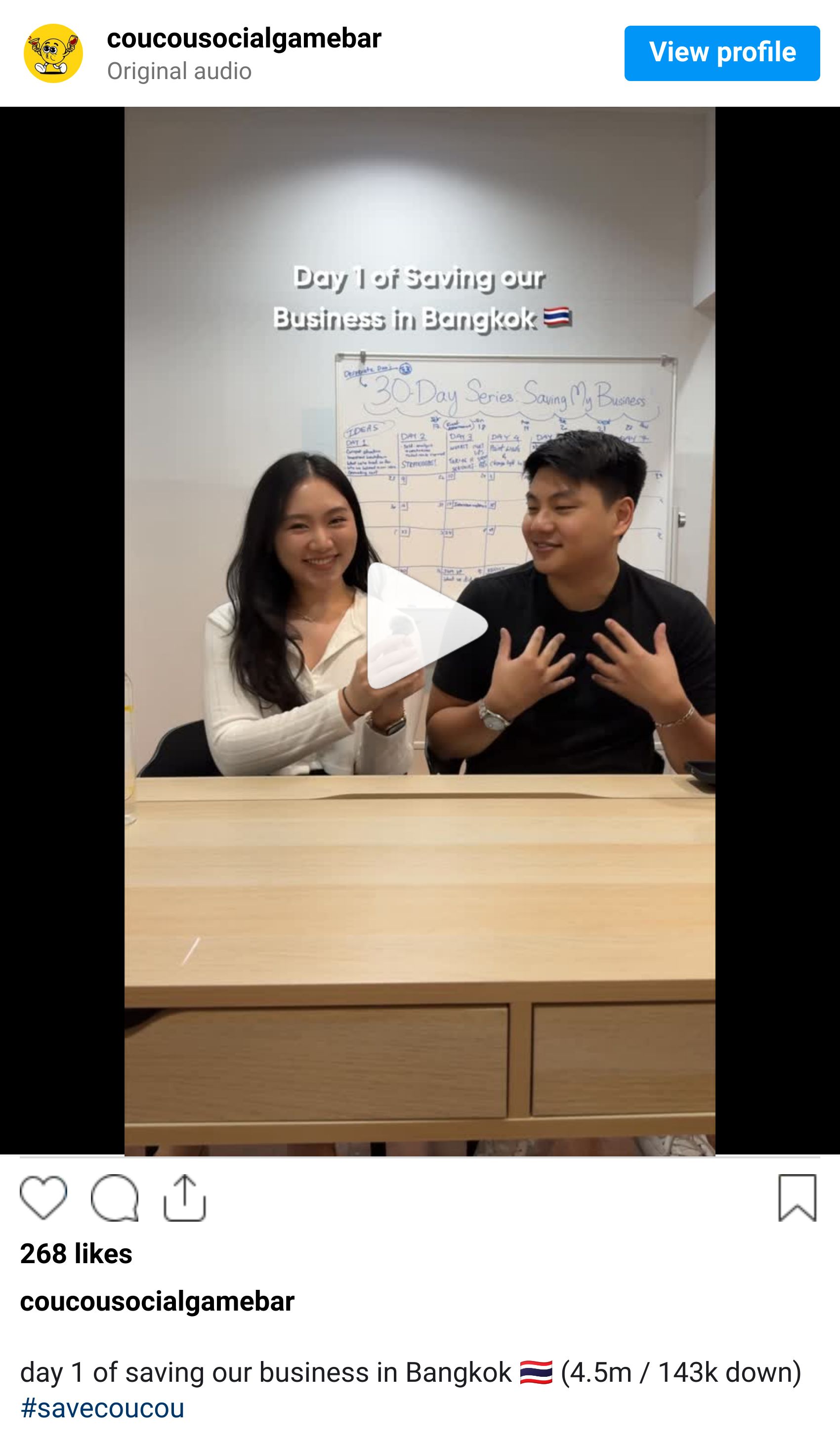
By January, they said the business had deteriorated enough that one of the influencers they hired suggested a different approach: stop selling the aesthetic and start documenting the struggle.
The idea made both founders uncomfortable.
Zeng admitted she preferred maintaining a polished online image. Dayot worried about family members in France seeing how badly the business was doing.
“It’s very vulnerable to put yourself out there and we’re scared to do that,” Zeng said.
But the couple eventually began posting transparent videos documenting their losses and uncertainty over whether Coucou would survive.
The response was stronger than any polished campaign they had previously run, they said.
Followers began showing up in support. Some stayed for events. Others shared the videos. Their monthly losses narrowed from around 100,000 baht to closer to 30,000 baht.
Coucou also began experimenting with events based on feedback from followers online, including Harry Potter trivia nights, Valentine’s Day mixers, chess tournaments and pet-friendly meetups.
They said their events are sometimes fully packed, particularly after influencer campaigns or themed nights, and videos posted on TikTok show crowded rooms of mostly non-Thai customers. Entry fees are usually charged during these events.
Still, as of May, the business remains in the red.
‘Barely surviving’
The pressure has also taken a personal toll. Dayot described living with constant anxiety over the possibility of losing their savings.
“Is it ever going to pick up?” he asked. “It’s so hard mentally to keep going every month.”
The couple told Soiciety they have considered closing the business, but for now, they decided to keep Coucou open despite the financial strain.
Asked what a successful version of Coucou would look like, they said it would mean reaching a point where customers come not out of sympathy or support for a struggling business, but because they genuinely want to be there.
“I don’t want to give myself the illusion that we’re successful business founders, because that’s not reality,” she said. “The reality is that we’re barely surviving right now, and that’s the current version of us.”
👀 What do you think is the biggest threat to the survival of independent social spaces in Bangkok right now?
📍 Support independent journalism
Understanding Bangkok shouldn’t depend on a marketing budget or a viral reel. Soiciety provides the ground-level reporting you use to move from being a guest to a resident who belongs. We won Asia’s Best Emerging News Provider because we look past influencer hype to spotlight the city’s reality.
We’re a reader-supported newsroom that answers to you, not advertisers or sponsors. Your membership is an investment in your life in Bangkok. Join our soi today to help us stay in the green!