

SOI ARI 4 FANG NUA, PHAYA THAI — On Harmish Muszid’s map of Ari, Noble Reflex marks the night he had a panic attack.
His cat had just died. His partner was away, and he hadn’t slept in 48 hours. He texted a friend in the building, who came over, brought him home and put him in the second bedroom. Harmish fell asleep almost immediately.
“It’s really precious, because I didn’t know the people who lived around there,” Harmish told Soiciety. “I feel like it’s like a safety net, like a home for me. The idea of a house is expanded, not just like a square room, but the whole neighborhood.”
On someone else’s map, the same spot held a different memory.
Before Noble Reflex was a condo, the site housed Reflections Rooms, a hotel that closed in 2009, where a different artist decorated every room.
“A lot of people from certain generations, if they're in their 40s approaching their 50s and working in the creative field, they will all mention that’s the place where the cool kids went,” Harmish said.
That layering — one address, multiple unrelated histories — led Harmish to spend two months collecting the oral history of Ari, a neighborhood he described as keeping a village-like feel despite its reputation for wealth.
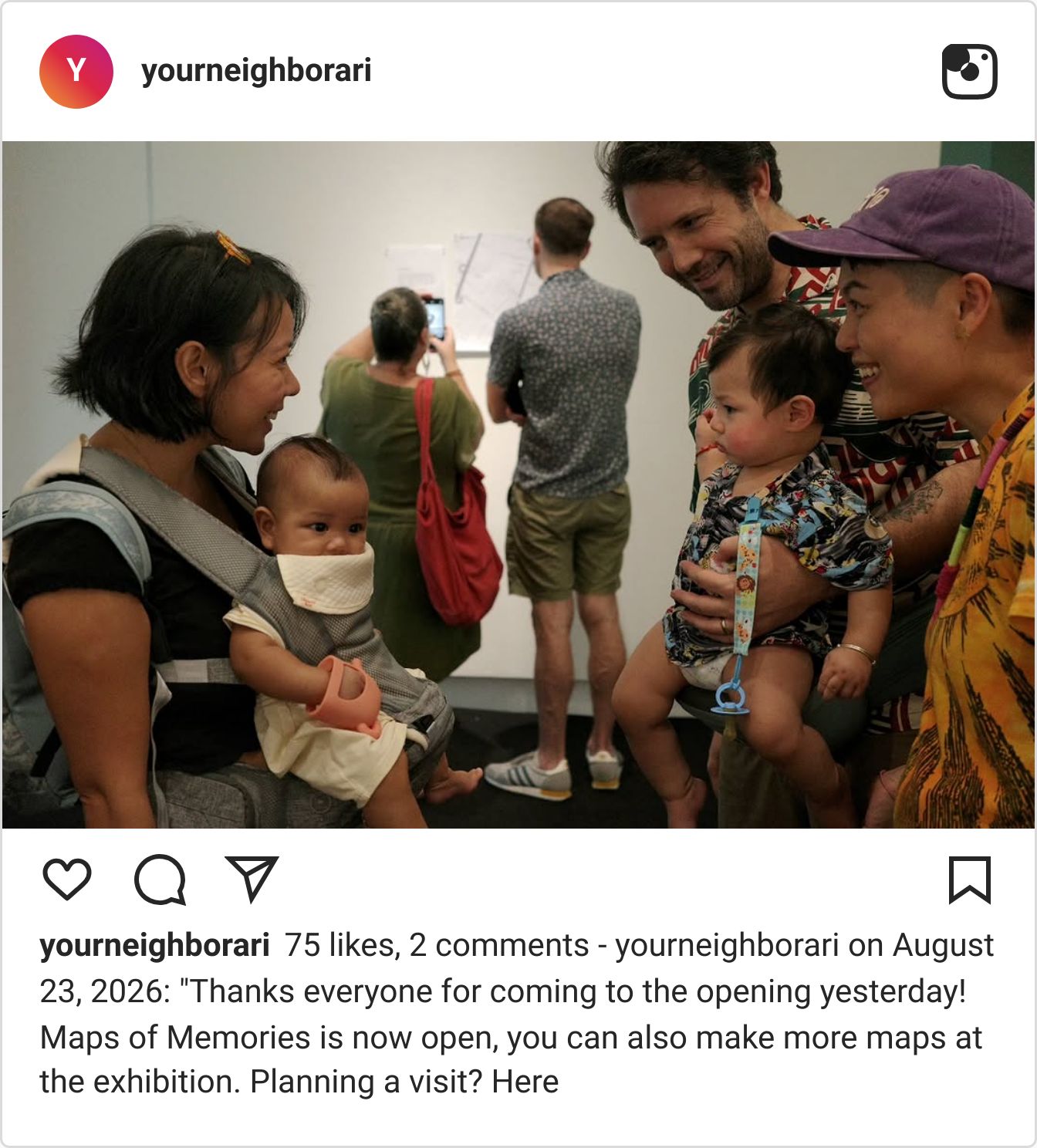
The result was “Maps of Memories,” an exhibition at Numthong Art Space that ran in late August. Current and former residents filled in blank neighborhood maps with what they remembered — and where.

Harmish Muszid looks at submitted maps inside his Ari apartment in Soi Phahon Yothin 7 in Phaya Thai, Bangkok, Thursday, Aug. 20, 2026. (Photo by: Chatwan Mongkol/Soiciety)
Harmish, 36, founded Your Neighbor Ari, a bilingual page profiling people who live and work in the neighborhood.
Before founding it, Harmish said he avoided his neighbors entirely.
“I was extremely shy,” he said. “I grew up thinking that the concept of neighbors is really far away, something you can only see on television, in movies, because I never really walked next door to talk to anyone before.”
Originally from Nong Chok, Harmish moved in with his partner in Ari in 2017. He said it wasn’t his choice of neighborhood and that he knew it only as an expensive area. Most days, he said, he went straight from home to work and back.
Then came the COVID-19 pandemic.
Harmish quit his job during what he called a “mental rupture,” unable to keep sitting through Zoom calls. He started walking around his neighborhood.
“It was slow enough for me to have questions to spark some curiosity,” Harmish said. “I’ve always wanted to know why this turned out like this and what this house used to look like, or who the house belonged to.”
One day, he went downstairs and talked to his building’s security guard — his first real conversation with a neighbor. That exchange became the seed of Your Neighbor Ari, which Harmish runs alone.
As he kept walking around, questions about the neighborhood led to more conversations and interviews.
“The questions go on and on,” he said. “Then people introduce me to more people, who introduce me to their grandmothers, and their grandmothers have a completely different version of what she remembers.”
Among others, the publication has profiled Ari’s last-standing newsstand, a satay vendor who has been selling in the soi since when a skewer cost a quarter of a baht and motorcycle taxi drivers.
Archiving oral history
The August map event was the first art exhibition Your Neighbor Ari had organized around residents’ memories.
The idea came out of years of interviewing people for the publication. Harmish said he kept hearing the same details from strangers or descriptions of places that no longer existed.
The IBM building on Phahon Yothin Road was one example. Older residents remembered it as a mall with a bowling alley called Thai Yong Tiang.
“I can see layers of memories landing on top of each other,” Harmish said. “I’m not sure how accurate that is, and I’m not sure which one comes first. But they’re all talking about the same space.”
He wanted to visualize that layering, so he handed out blank maps of the neighborhood and asked people to fill them.
More than 80 residents participated.
Without instruction, Harmish said most people started with just a name — a restaurant, a bar and a cafe. With a nudge, the memories got more personal: a first date, a breakup and a place they used to sit.

A submitted map of Ari (Photo by: Chatwan Mongkol/Soiciety)

Another submitted map (Photo by: Chatwan Mongkol/Soiciety)
One 84-year-old resident’s map showed vegetable patches and open grass where the neighborhood now stands, before Phahonyothin Road turned the area into one of Bangkok’s first car-based residential areas.
One linked locations with pins, in what Harmish described as looking like a crime-investigation movie. Another placed a coffee mug on the map to leave a ring.
“He thinks that’s something that only happens at homes, and his map is creating a piece of art that talks about his comfort zone at home,” Harmish said. “I always encourage people to break the rules and be creative with it.”
The exhibit wasn’t meant to inform people about Ari but to remind them that neighbors can live in the same place and still inhabit different versions of it.
“I want people to know they’re only one step away from connecting,” Harmish said.
He hopes Your Neighbor Ari can provide basic neighborhood information to give people “a little courage to go up to each other.”
“Everyone has something, a story, a memory of their own,” he said. “It’s just waiting for someone to ask.”
🚪 How well do you know the people living immediately next door to you?
🌟 Become a Soi Resident today
Are you getting local context and framing you can’t find anywhere else? Do you understand Bangkok better now than before you found Soiciety? If you use this information to navigate your city, you’re already using Soiciety as a service.
🙌 Help sustain the reporting that gives you the full picture of Bangkok. Become a paying reader today for $15/month!